Overview
IMDF (Indoor Mapping Data Format) is Apple's open spec for publishing indoor maps to Apple Maps, and closely aligns with Google's equivalent for Google Maps. At Spatial Topology I independently researched the spec, built the company's first IMDF pipeline alongside an internal editor tool, and led the first public rollout at Taiwan Taoyuan International Airport.
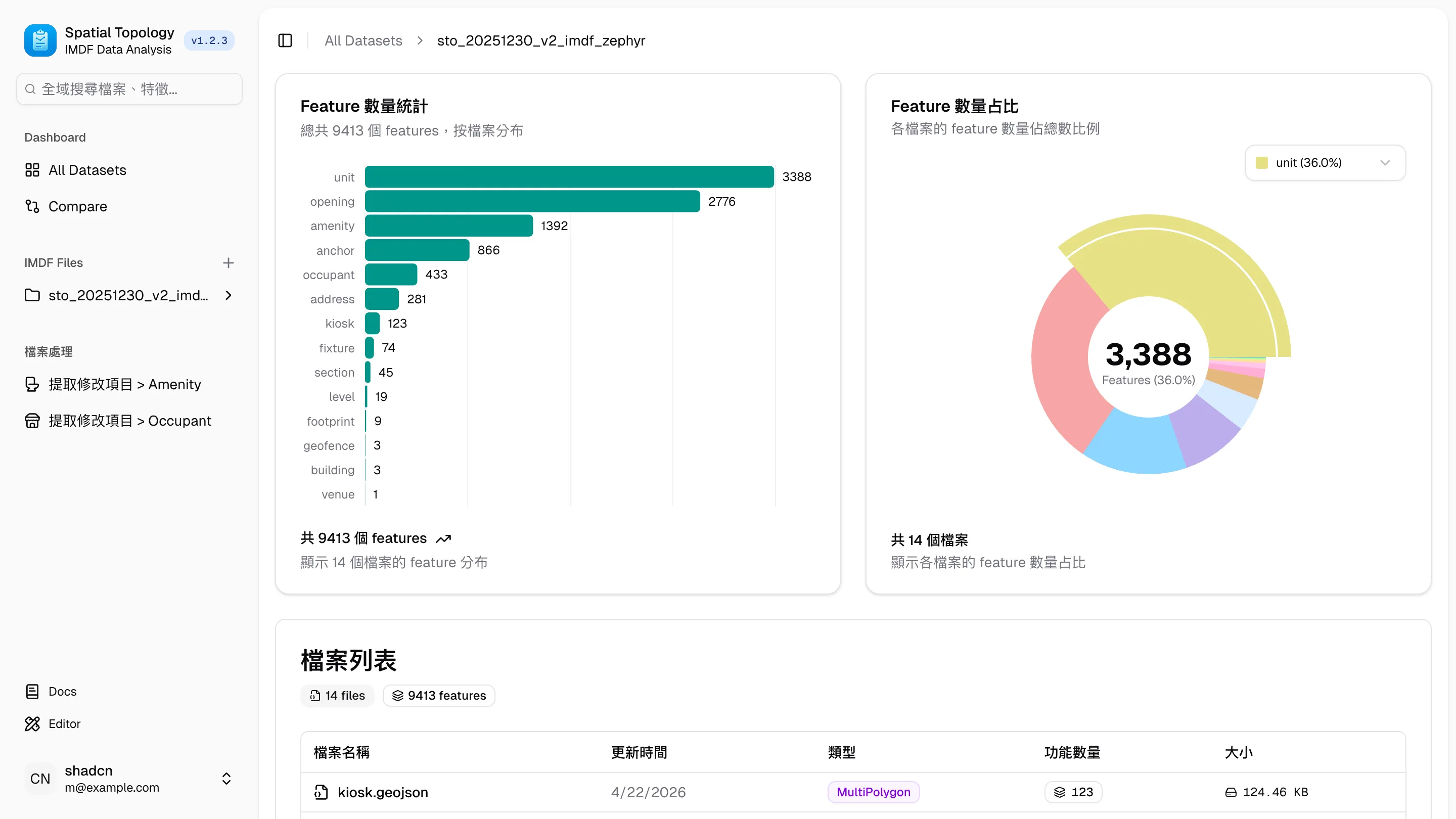
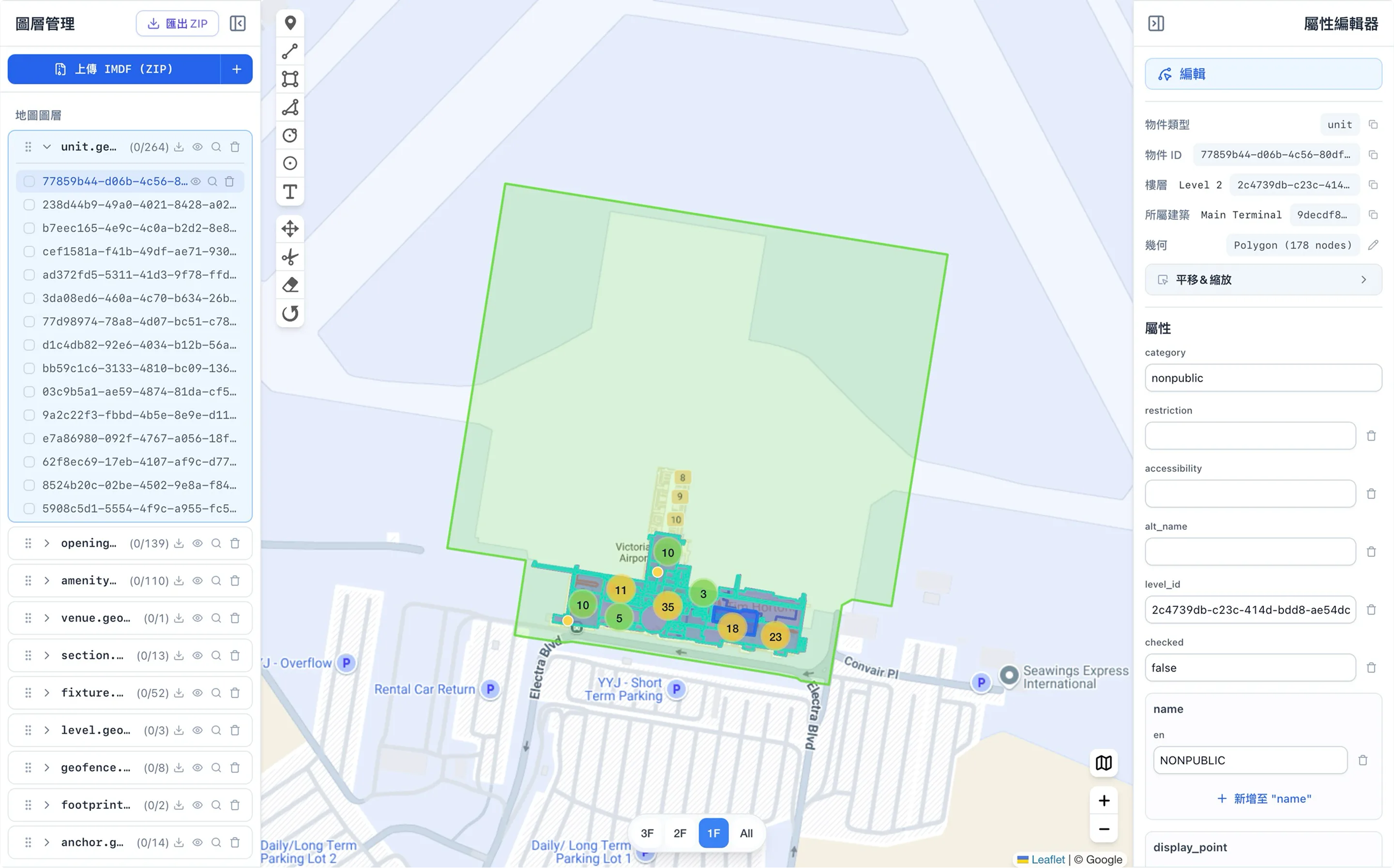
Two sides of the pipeline: the internal editor used to author IMDF, and the analytics dashboard shared with airport operations.
Challenge
Spatial Topology's indoor maps lived in a bespoke internal format optimised for their own SDK. That format didn't export anywhere else, which meant every enterprise client had to rely on the company's proprietary apps to view their own venue — and the maps couldn't appear in Apple Maps or Google Maps at all. Large clients like Taoyuan Airport asked repeatedly for native-map integration; without a pipeline, each request was manual and each delivery slipped.
Approach
- Studied the IMDF spec (Apple's open GeoJSON-based schema) and mapped every field against the company's internal map model to identify conversion gaps.
- Designed and built an internal IMDF editor — a web tool that lets the team load existing map data, resolve schema mismatches visually on a Leaflet canvas, and export valid IMDF. Shipped as a lightweight stack (HTML, Tailwind CSS, Leaflet), built AI-native in Cursor with Claude and Gemini 2.5 Pro.
- Authored an internal IMDF reference guide so subsequent integrations wouldn't re-discover the same edge cases.
- Designed an analytics dashboard for clients to monitor their live IMDF deployment, using V0 by Vercel to rapidly prototype feature sets and validate them with Airport stakeholders before engineering commit.
- Piloted the full pipeline across two four-story university buildings as earlier reference sites, then led the Taoyuan Airport rollout and ongoing updates.
Results
- Established the company's first repeatable pipeline from internal map data to Apple Maps and Google Maps.
- Shipped the first public IMDF deployment for Taiwan Taoyuan International Airport, with recurring updates as airport infrastructure changes.
- Two four-story university buildings deployed successfully as earlier reference sites.
- Handed the pipeline over as three reusable artifacts the team still operates:
- Internal IMDF editor — lets the team onboard new venues without re-deriving the schema each time.
- Analytics dashboard used internally and shared with airport operations to monitor the live deployment — imdf-tool.sto-tek.com.
- Written reference guide so subsequent integrations don't re-discover the same edge cases.